 Have you ever been insulted and called a blockhead? It's not fun, especially when you're actually smart. I want to introduce you to another Leonardo -- Leonardo of Pisa, also known as Leonardo Fibonacci. This Leonardo loved numbers that he thought about them all the time. In class, he was so smart that he'd finish his work early, start daydreaming about math riddles of his own inventions, and tick the teacher off! Many of the world's brightest minds were often daydreamers, so Leonardo Fibonacci fit that pattern perfectly! When Leonardo was grown up, he wrote a book about Hindu-Arabic numerals [basically, the number system we all use today], and he threw in some math riddles. One of the math riddles was about how fast rabbits can multiply. Now, if you've ever had a pair of male and female rabbits, they can have a lot of babies over the course of a year. You can get stuck with a lot of rabbit families, whether you want them or not. Leonardo discovered that in nature, whether we're talking about rabbits or shells or flowers, there is a magical numerical code which comes up time and time again. He found one of nature's most important codes! Today we call this code the Fibonacci sequence, after Leonardo. If you want to find out more about this amazing code, read Blockhead: The Life of Fibonacci by Joseph D'Agnese.
Showing posts with label genius. Show all posts
Showing posts with label genius. Show all posts
Saturday, July 17, 2010
Cool Brainiacs: Booktalk 2
Have you ever been insulted and called a blockhead? It's not fun, especially when you're actually smart. I want to introduce you to another Leonardo -- Leonardo of Pisa, also known as Leonardo Fibonacci. This Leonardo loved numbers that he thought about them all the time. In class, he was so smart that he'd finish his work early, start daydreaming about math riddles of his own inventions, and tick the teacher off! Many of the world's brightest minds were often daydreamers, so Leonardo Fibonacci fit that pattern perfectly! When Leonardo was grown up, he wrote a book about Hindu-Arabic numerals [basically, the number system we all use today], and he threw in some math riddles. One of the math riddles was about how fast rabbits can multiply. Now, if you've ever had a pair of male and female rabbits, they can have a lot of babies over the course of a year. You can get stuck with a lot of rabbit families, whether you want them or not. Leonardo discovered that in nature, whether we're talking about rabbits or shells or flowers, there is a magical numerical code which comes up time and time again. He found one of nature's most important codes! Today we call this code the Fibonacci sequence, after Leonardo. If you want to find out more about this amazing code, read Blockhead: The Life of Fibonacci by Joseph D'Agnese.

Friday, July 16, 2010
Cool Brainiacs: Booktalk 1
 [Booktalker: Before you booktalk, put a tab or bookmark the page with the Wright Brothers.]
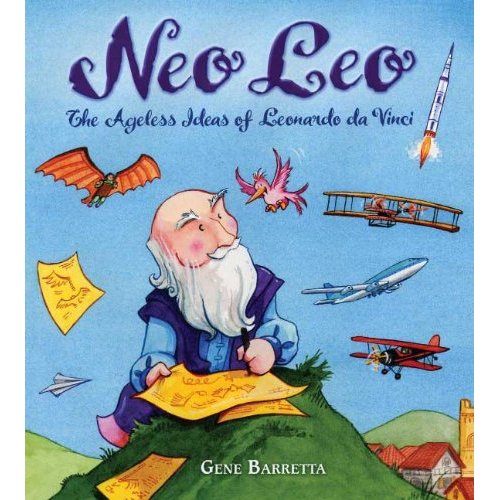
Leonardo da Vinci -- let's call him Leo -- was one of the greatest minds of all time. He was interested in absolutely everything. He lived hundreds of years ago in Italy, and he loved to take notes: all kinds of notes - notes on inventions, designs, and ideas. You know what's so cool about his notes? He used mirror writing - in order to read the notes, you have to hold them up to a mirror! If you check this book out, get a mirror ready, because there's some mirror writing to decipher. Back to Leo -- he was way, way ahead of his time. Many of his "inventions" only existed in his notes - they never got made into real life prototypes until thousands of years later [showcase page with Wright brothers and Leo's "ornithopter"]. If we look at this picture of the Wright brothers in 1903, and this picture of Leo's "ornithopter," 400 years before that, we see that Leo thought of it first! [Turn the page to the hang gliders]. Leo even thought of hang gliders and drew them up as designs, long before the first successful hang glider was successfully flown. His mind was amazing. His designs were brilliant. This is a fun, fascinating book: Neo Leo: The Ageless Ideas of Leonardo da Vinci by Gene Barretta.
Subscribe to:
Posts (Atom)