Showing posts with label authorship. Show all posts

Friday, May 16, 2014

Book talk: What's Your Favorite Animal? by Eric Carle and Friends

Eric Carle's Fiffi
Think of your favorite authors: they all have favorite animals, just as you do. Remember The Very Hungry Caterpillar author, Eric Carle? He had a cat named Fiffi who loved string beans. Eric could play fetch with her, throwing the string beans! At one point, Fiffi picked up a string bean, walked into a closet, put the string bean in his shoe, and fell asleep, curled around the shoe!


His eye reminds me of the Pigeon's eye!
Remember how funny Mo Willems' Pigeon books are? Mo Willems is just as funny. [Read his favorite animal out loud.] Where is that animal in this picture? [Wait for responses.] Right: it's in the stomach of the snake!

[Show Leopard by Lucy Cousins but cover up her name.] One of the authors loves leopards. Does this illustration style look familiar to you? [Wait.] This author loves red, yellow, and outlining in black. Right: it's the author of the Maisy books -- Lucy Cousins.

Have you read This is Not My Hat or I Want My Hat Back? Jon Klassen has a great, sly sense of humor. I'm not going to tell you his favorite animal, but try to guess it before you read this book. There is a great list of author biographies in the back: you get to see what the authors looked like as children and learn more about them.

What's Your Favorite Animal? by Eric Carle, Nick Bruel, Susan Jeffers, Steven Kellog, Jon Klassen, Tom Lichtenheld, Peter McCarthy, Chris Raschka, Peter Sis, Lane Smith, Erin Stead, Rosemary Wells, Mo Willems. Unpaged. 2014: Henry Holt and Company. Booktalk to K-2.

Wednesday, December 1, 2010

Just Write: Booktalk 4


If you like to write – you know, the writing you do for yourself and not just required school writing – you probably know that it’s one of those “easier said than done” activities. Spilling Ink is a great book to get you inspired to write, and it’s funny and helpful, too. It’s got a bunch of “I dare you”s for your writing – to get you going or to keep you going – and it’s even got an Official Writer’s Permission Slip [show page 7]. What I liked most about Spilling Ink is how it explains the messy writing process and the importance of re-writing. Think of your favorite book of all time: did you know the author may have re-written that book up to 20 times? That’s normal, even if it does sound weird. Future novelists out there, if you like writing fiction, this book has great ideas for coming up with a plot, inventing characters, and writing dialogue. You can read part of it or all of it, depending on what advice you need. The author interviews at the end are pretty funny, too. One of the writers has slammed her head on the desk, yelled, “This is hard!” [the writing, not the desk] and then had a strawberry Twizzler to feel better. Spilling Ink: A Young Writer’s Handbook by Anne Mazer and Ellen Potter.

Spilling Ink: A Young Writer’s Handbook by Anne Mazer and Ellen Potter. 275 p. Roaring Book Press, 2010. Booktalk to intermediate grades, middle school, high school.

Saturday, November 27, 2010

Just Write: Booktalk 3


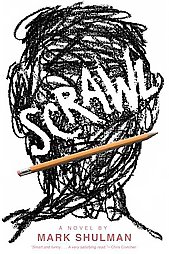
Tod Munn is one of those kids you have to watch out for in school. He’s tough, he’s mean, he will fight you if necessary, and he’s familiar with detention and suspension. The teachers think of him as one of the bad kids. In Tod’s defense, though, he doesn’t have a lot going for him. He’s from a poor family, and his dad left a while ago. It’s normal for him to have no breakfast or lunch, unless he gets a free one from school. But we find out something very surprising about Tod: he’s a really good writer – funny, smart, and engaging. Of course, he’s being forced in write in a journal in detention which lasts one month, under the watchful eye of the guidance counselor. When you start to read Tod’s journal, you realize so many things about him and about the other kids and teachers at his school. Without giving away too much, you might start to realize that Tod is really kind of amazing, and so is what he “scrawls” in detention. Scrawl by Mark Shulman.

Scrawl by Mark Shulman. 230 p. 2010: Roaring Book Press. Booktalk to middle school, high school.

Tuesday, November 23, 2010

Just Write: Booktalk 2


[Ask your teen readers which books they have read by Hemingway: The Sun Also Rises; A Farewell to Arms; For Whom the Bell Tells; The Old Man and the Sea, etc.]

What do you think of when you think of the typical writer? [Get a few responses.] Ernest Hemingway probably wasn’t like any of those. He loved to drink, to hunt, to go on safaris, to fight, and to watch bullfights. Basically, he was a restless adrenaline junkie. He loved women and was married four times. He would not mince words, either in real life or in his writing; in fact, he could be really mean to his friends and even to his family. He believed in getting right to the point and to living life to the fullest. [Show photograph on p.4: Hemingway with the huge tuna]. Hemingway had to be the best at everything: whether it was killing large game in Africa, catching the largest fish, writing the best novel, or winning an argument. This book gives a good mix of photos, stories, and facts about Hemingway’s life. Even though Hemingway was and is a major success, he struggled with alcohol and depression and failures. Reading about his life may evoke different responses from you – the end of his life, which ended in suicide, was pretty sad. And yet he is one of America’s greatest writers. His life was fascinating and enigmatic. Read about it in Ernest Hemingway: A Writer’s Life by Catherine Reef.

Ernest Hemingway: A Writer’s Life by Catherine Reef. 183 p. Clarion, 2009. Booktalk to 8th grade and above.

Saturday, November 20, 2010

Just Write: Booktalk 1


Teens mostly e-mail, text, IM, or call each other nowadays, right? Dash and Lily are completely different. They met by notebook, and it stayed that way for a while. Let me explain. Dash, short for Dashiell, is in his favorite bookstore in New York City, and on the shelves he finds a red moleskin notebook with handwritten instructions involving a challenge, and not an easy one. The challenge – if done correctly – will get the notebook back to its owner. The challenge involves writing, intelligence, willingness to make a fool out of himself, and some luck. And so the game starts. Dash and Lily don’t actually meet for a while. They couldn’t tell you what the other one even looks like: they’re both blanks to each other, in that respect. They start sharing through writing: thoughts, memories, aspirations – you know, the kind of stuff it’s easier to write that to say out loud. But both harbor a desire to meet in real life, yet the signs are there that they won’t and can’t have the type of relationship that they had through the notebook. What if meeting in real life ruins everything? Read Dash & Lily’s Book of Dares by Rachel Cohn and David Levithan.

Dash & Lily’s Book of Dares by Rachel Cohn and David Levithan. 260 p. Knopf, 2010. Booktalk to high school.