Tuesday, February 26, 2013

Book talk: Creepy Carrots (Caldecott honor, 2013)

 
[For this booktalk you will need three or four props: one prop must be a real or fake carrot. The others can be scary, Halloween-like things: a scary mask, a picture of a ghost, a little skeleton, a picture of a haunted house, etc.  Don’t show the cover until you’re done with your prop intro.]
I have four items for you to examine today. A picture of a ghost, a little skeleton, a goblin mask, and a carrot. [Let them observe for a few seconds.] Talk to me about this group. Which item does not fit in? The carrot? Why doesn’t the carrot fit in? [Hopefully, one of the kids will say that it isn’t scary but the other items are.] Carrots aren’t scary? Are you serious? Does this mean you’re not afraid of carrots?
[Now you can show the book’s cover.] But what if you were haunted by creepy carrots? You thought they were harmless: you are so, so wrong, and that’s what Jasper Rabbit thought. He loved carrots, and he would just plop himself down in Crackenhopper Field gorging himself on carrots. They were his passion, but he is a rabbit, after all.
One day he was just minding his own business, about to pick some carrots, when all of a sudden, he thought he heard carrots creeping up behind him. He turned around, but there was nothing there.
But that night, in the bathroom mirror, as he was brushing his teeth: THERE THEY WERE!!!!! Creepy carrots out to get him!
Imagine living your life, the life of an innocent carrot-eating rabbit, while knowing that carrots are stalking you, watching you, and breathing their creepy little carroty breath right behind your back.
Creepy Carrots by Aaron Reynolds, illustrated by Peter Brown. Simon & Schuster Books for Young Readers, 2012. Unpaged. Booktalk to K-2. Caldecott medal honor book, 2013. Great quick read-aloud.

Tuesday, February 19, 2013

Book talk: Underground by Shane Evans (Virginia Readers' Choice, 2012-2013)


For this booktalk, I’m going to ask you close your eyes and keep them shut. I want you to pretend that you’re a young African-American slave, and you and your family are trying to escape to freedom. You’re terrified. It’s dark, and you have to be absolutely silent and creep out of the master’s house and into the woods. You don’t know which is more horrifying: the journey you’re about to take, or the prospect of getting caught. The other slaves’ eyes are full of fear, and so are your parents. You don’t know where you are going, but you do know that you’ll always travel by night and you must be absolutely silent no matter what. You have to be braver than you think you can be, because now you’re part of the slaves’ underground railroad to freedom.

Underground: Finding the Light to Freedom by Shane W. Evans. Unpaged. Roaring Book Press: 2011. Booktalk to primary grades. Virginia Readers’ Choice, 2012-2013.

Tuesday, February 12, 2013

Book talk: Say Hello to Zorro! by Carter Goodrich (Virginia Readers' Choice)


[Hold up cover, but cover up with your hand the part of the illustration which shows Zorro, the smaller dog].

This is Mister Bud [the larger dog on the cover]. Mister Bud has a great life for a dog. Dogs love a set schedule, and Mister Bud is no exception. He’s got his own house, his own bed, his own toys, his own dish, and a time for everything.


 Do you know how important his schedule is to Mister Bud? It is everything. He has his biscuit before his walk. When his owner comes home, it’s “greet and make a fuss time,” followed by quick backyard time, dinnertime, walk time, and then movie time. Yes, Mister Bud loves his movies. What dog doesn’t? What a perfect, happy, orderly life.

[Show cover, and take your hand off so that Zorro is now showing.] Oh my gosh, who is this? A new dog? A new dog in Mister Bud’s house? Oh dear. What is the expression on this little dog’s face? [Get a few responses.] Right, he looks angry. This is Zorro, and he’s little and fierce. Does Mister Bud look happy about this? [Absolutely not!]

To add insult to injury, this book is titled, “Say Hello to Zorro!” And that’s what Bud’s owners said to him when they brought Zorro home. Is trouble brewing?

Say Hello to Zorro! by Carter Goodrich. Unpaged. Simon & Schuster Books for Young Readers, 2011. Booktalk to preschool through 1st. Virginia Readers’ Choice, 2012-2013.

Book talk: City Dog, Country Frog by Mo Willems (Virginia Readers' Choice)


[For this booktalk, put a sticky tab on the following pages: pages {4-5}: “City Dog spotted something…”, pages {22-23, rainy day}, pages {28-29, frog sits on dog’s nose}, and pages {30-31:dusk}.

[Show cover.] Do frogs and dogs hang out together? [Invite brief discussion.] Okay, so maybe they don’t usually hang out and befriend one another.

But City Dog is unique. [Show pages 4-5] He was out in the countryside, probably on vacation, when he spotted a frog, quietly sitting on a rock. He talked to frog, and it turned out that frog was waiting for a friend. Frogs are like that. [Turn the page.] Frog knows all sorts of country games that city dog does not know, and he’s happy to teach city dog. [Turn the page.] What could be more fun than playing in a creek? [Turn page.] I think this picture is one of my favorite picture book pictures ever: city dog is giving country frog a ride on his head in the creek.

But not everything they do is funny like that. Friendship is made of quiet activities too: enduring rainy days [show pages 22-23], talking [show pages 28-29], and just hanging out [show pages 30-31]. All friendships are special, but there is something unique about the friendship of city dog and country frog.

City Dog, Country Frog by Mo Willems, pictures by Jon J. Muth. Hyperion, 2010. Unpaged. Booktalk to preschool – 2nd grade. Virginia Readers’ Choice, 2012-2013.

Thursday, January 24, 2013

Book talk: Mirror Mirror: A Book of Reversible Verse (Virginia Readers' Choice, 2012-2013)


Did you look in the mirror this morning? Mirrors are funny. They show us a reversed image of ourselves. This book, Mirror Mirror, is all about reversals in fairy tales, a really fun topic, because reversals are everywhere in fairy tales: the poor, abused girl becomes the rich, beloved princess; the ugly duckling becomes the beautiful swan; the old crone becomes the young girl. There are reversals of appearance, of reality, and of good/evil.

"In the Hood," a reverso poem
But what if you made a poem, called a reverso, about this? Reversos are deceptively simple. I’m going to read you my favorite one. [Read your favorite reverso to the kids while showing them the accompanying picture: I like “In the Hood”]

[While explaining the reverso format, turn the pages so they can see others…] A reverso poem is like a puzzle: you read it, going down, as you would normally read. If you then took them bottom lines and put them at the top, reversing the order, you’re using exactly the same words but somehow, mysteriously, the meaning changes. Look carefully or you’ll miss it.

Mirror Mirror: A Book of Reversible Verse by Marilyn Singer, illustrated by Josee Masse. Dutton Children’s Books: 2010. Booktalk to elementary (I would use it for 1st through 5th). Virginia Readers’ Choice, 2012-2013.

Book talk: The Trouble with Chickens (Virginia Readers' Choice, 2012-2013)


J. J. Tully, 'retired' rescue dog

Search and rescue dogs are really cool and really smart. They use their keen sense of smell, orders from humans, and animal intuition to find missing people. It’s a noble job. J. J. Tully is a rescue dog. He has found many missing people by sniffing them out of rubble, snow, darkness, and danger. But now he’s got a mother chicken harassing him. Wait…a mother chicken? Why would a mother chicken harass a rescue dog? Oh, right…missing chicks. So, how hard can it be to find a bunch of missing chicks? Hold on, let me ask J. J. Tully. [Pause.] Okay, much harder than finding humans. Humans stink. You can smell them miles away. 

A chick trail is much harder, especially when it’s pouring rain, you’ve got a mom chicken and two other chicks right behind you and a cryptic ransom note. This was the weirdest ransom note I have ever read. I have to read it to you. It says, “I have your peeps. It behooves you to rendezvous. Twilight. Your place.” What?!?! Who talks likes this? This is going to be one crazy, weird mystery.

The Trouble with Chickens: A J. J. Tully Mystery by Doreen Cronin, illustrated by Kevin Cornell. 119 pages. Balzer + Bray, 2011. Booktalk to intermediate grades. Virginia Readers’ Choice, 2012-2013.

Book talk: I Need My Monster by Amanda Noll (Virginia Readers' Choice, 2012-2013)


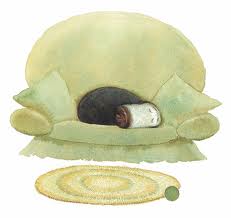
When I was your age, I was afraid to look under my bed at night because that’s where the monsters live. Don’t laugh. I know you feel the same, but you don’t have to admit it. Ethan actually knows the monster under his bed. Yeah: they’re buddies. Isn’t that weird?

Ethan is a lot braver than I am, but he’s got a problem: his monster is going out of town for a week. Don’t ask me why, but Ethan has to have a monster under his bed. He will NOT be without one, so he starts interviewing monsters to see which one is suitable to stay under his bed at night! I know: I don’t get it, either.

How hard can it be to find the right monster? Okay, one was wearing a bow, one had an absurdly long tongue, and one was green but not scary. Agghhhhh!!!! How many monsters does a boy have to interview before he finds one appropriately terrifying to stay under his bed?

 I Need My Monster by Amanda Noll, illustrated by Howard McWilliam. Unpaged. Booktalk to K-2. Virginia Readers’ Choice, 2012-2013.